
Ranked choice voting vs runoff compares preferences recorded on one ballot with a new opportunity to vote. In the single-winner ranked method discussed here, voters rank candidates and the count can transfer ballots after an elimination. In a two-round election, the remaining candidates can face each other in a separate vote.
Both can narrow a contest to fewer candidates, but they do not collect information in the same way. A ranking states what a voter prefers among alternatives on the original ballot. A second election records a choice at a later voting occasion. Treating those as identical hides the main difference.
Ranked choice voting vs runoff: define the methods first
“Ranked choice” can describe more than one electoral arrangement. This article uses it for a single-winner instant-runoff count, also called the alternative vote. It does not describe a multi-seat proportional system. Likewise, the comparison uses a specified two-round arrangement with a majority requirement in the first round and a contest between the top two if nobody reaches it.
International IDEA's Electoral System Design database distinguishes the alternative vote from two-round systems. Its categories are a useful reminder that ballot design and counting rules need to be identified before comparing outcomes. Not every election called a runoff uses exactly the same thresholds or procedures.
For the example below, there is one seat, three candidates and 100 valid ballots. The candidates are simply A, B and C, with no party labels or policy positions. The numbers are invented to show a counting rule, not taken from an election or a poll.
Follow the ranked count from 42–35–23
The first preferences are A with 42, B with 35 and C with 23. Nobody has more than half of the 100 votes. Under the stated instant-runoff rule, C has the fewest first preferences and is eliminated. The count then examines the next eligible preference on each of C's ballots.
Assume all 23 C ballots identify a remaining candidate. Seven rank A above B, while sixteen rank B above A. Those ballots transfer accordingly. A keeps its 42 ballots and receives seven, reaching 49. B keeps its 35 and receives sixteen, reaching 51. B wins this fictional count.
| Count stage | A | B | C | Continuing ballots |
|---|---|---|---|---|
| First preferences | 42 | 35 | 23 | 100 |
| Transfer from eliminated C | +7 | +16 | −23 | 100 |
| Final count | 49 | 51 | Eliminated | 100 |
A transferred ballot does not give its voter extra simultaneous votes. Before elimination it counted for C. After elimination it counts for A or B, according to the recorded ranking. Each continuing ballot contributes to one candidate's tally at a time.
The totals also provide a simple arithmetic check: 7 + 16 = 23, and 49 + 51 = 100. Nothing is added to the electorate during the count. A's first-round lead does not guarantee victory because the original rankings contain further information about voters whose first choice is eliminated.
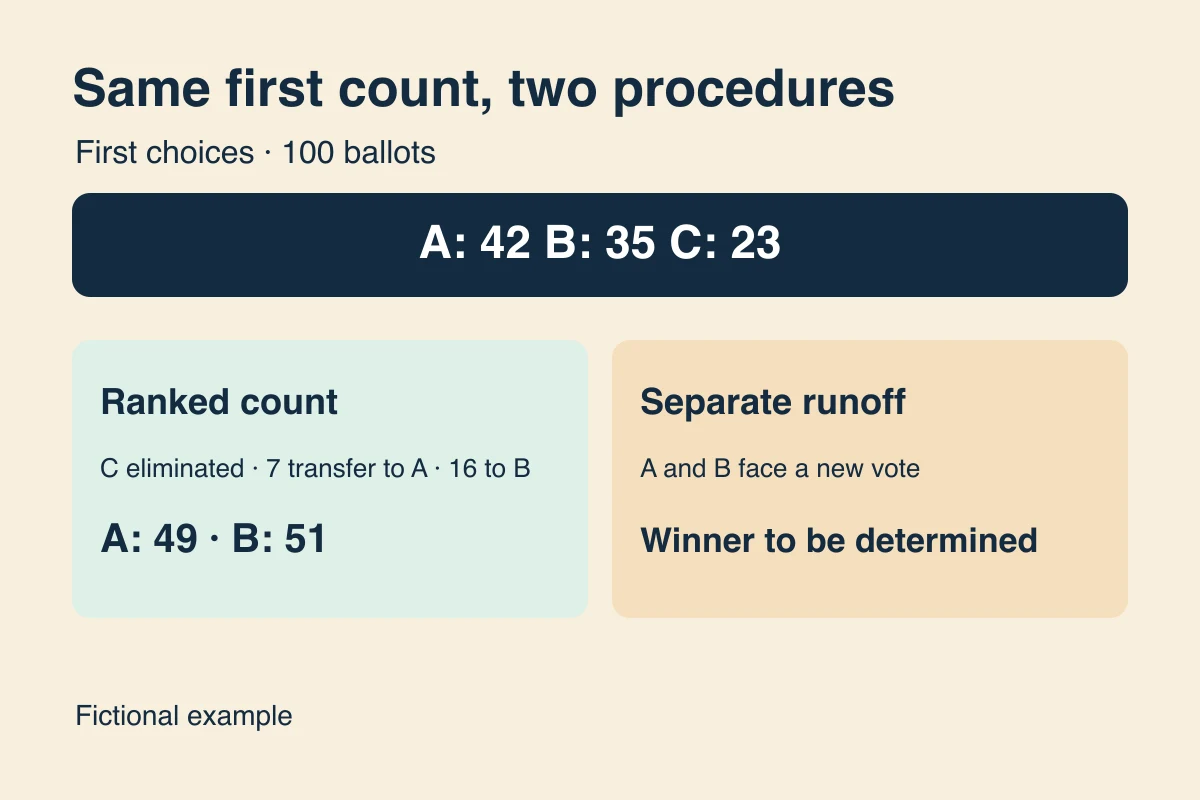
The chart is an illustrative calculation under explicitly assumed rankings. The cover is a conceptual illustration. Neither image predicts an actual election or assigns political views to any candidate.
A second round asks a new question
Now apply the stated two-round arrangement to the same first-round totals. A and B advance because they have the two largest totals; C does not. The second round then asks voters to make a new choice between A and B. We have not supplied the ballots for that vote, so we cannot name its winner.
That is the key distinction in ranked choice voting vs runoff. The 7-to-16 transfer split is information we invented for the ranked ballots. It is not evidence that the same people would divide that way in a later election. Some might change their minds or not participate, while other eligible voters might participate in the second round.
Candidates can also campaign between rounds, and voters can consider the changed contest. These possibilities do not tell us which direction an outcome would move. They explain why copying the 49–51 result into the separate-election column would make an unsupported assumption.
For a comparison focused only on arithmetic, someone could explicitly assume identical participation and identical final preferences. That would be a different exercise. Here, the second-round result remains unknown because the purpose is to distinguish a transfer of existing ballots from the collection of new ones.
Exhaustion changes the continuing-ballot total
Our ranked example deliberately has no exhausted ballots. Every ballot initially supporting C provides an eligible preference for one of the remaining candidates. Real counting rules may allow incomplete rankings, and a ballot with no remaining eligible preference can stop contributing to later candidate tallies.
Suppose a ballot names only a candidate who has been eliminated. The counter cannot invent a preference for someone else. Depending on the applicable rules, that ballot may become exhausted. Any later percentage must therefore make clear which ballots form its denominator: all original valid ballots or those still continuing in the count.
This article does not replace the example's transfer figures with a second numerical scenario. The 49 and 51 totals rely on all 100 ballots continuing. A different exhaustion assumption would require a new calculation, not merely a different label on the same chart.
Counting procedures, ballot-validity requirements and winning thresholds should be read together. The existence of rankings alone does not establish how every possible ballot will be treated. The broad name of a system is a starting point for those questions.
What the comparison does not measure
The example measures no campaign cost, voter satisfaction, turnout effect or administrative workload. A single voting occasion and a separate later vote involve different processes, but a claim about which is cheaper or more accessible would need evidence from the relevant setting.
Nor does a first-preference tally reveal everyone's complete ranking. We had to state the C voters' next preferences separately. Assuming those preferences from a candidate's label or from another election would defeat the purpose of a transparent worked example.
Our earlier explanation of proportional representation and district plurality concerns a different question: how votes produce multiple seats across constituencies. The present example selects one winner. A majority-oriented single-seat count should not be confused with proportional allocation among several winners.
Relating electoral rules to political preferences
The twelve axes overview separates questions about representation and authority from other political preferences. Favoring a ballot format does not by itself establish views on taxation, civil liberties or the distribution of power between regions and a national government.
The methodology explains how answers become the site's results. It does not turn the fictional A, B and C into ideologies or rank real electoral systems by democratic quality. No scores are assigned to the candidates or the imagined electorate.
To explore your wider views, take the 12 Axes test. When considering voting rules, keep three things separate: what voters record, how the count uses that information and what evidence would be needed to evaluate the resulting institutions.