Personality tests
Love Language Test: How Do You Give and Receive Love?
This free love language test asks you to rate 30 short statements about how you give and receive love with partners, family and friends. Your result scores all five love languages, names the one that stands out most and shows how close the others came. It takes about five minutes, there is no account to create, and your answers never leave your browser.
- Statements
- 30
- Types
- 5
- Minutes
- 4
01
What this love language test measures
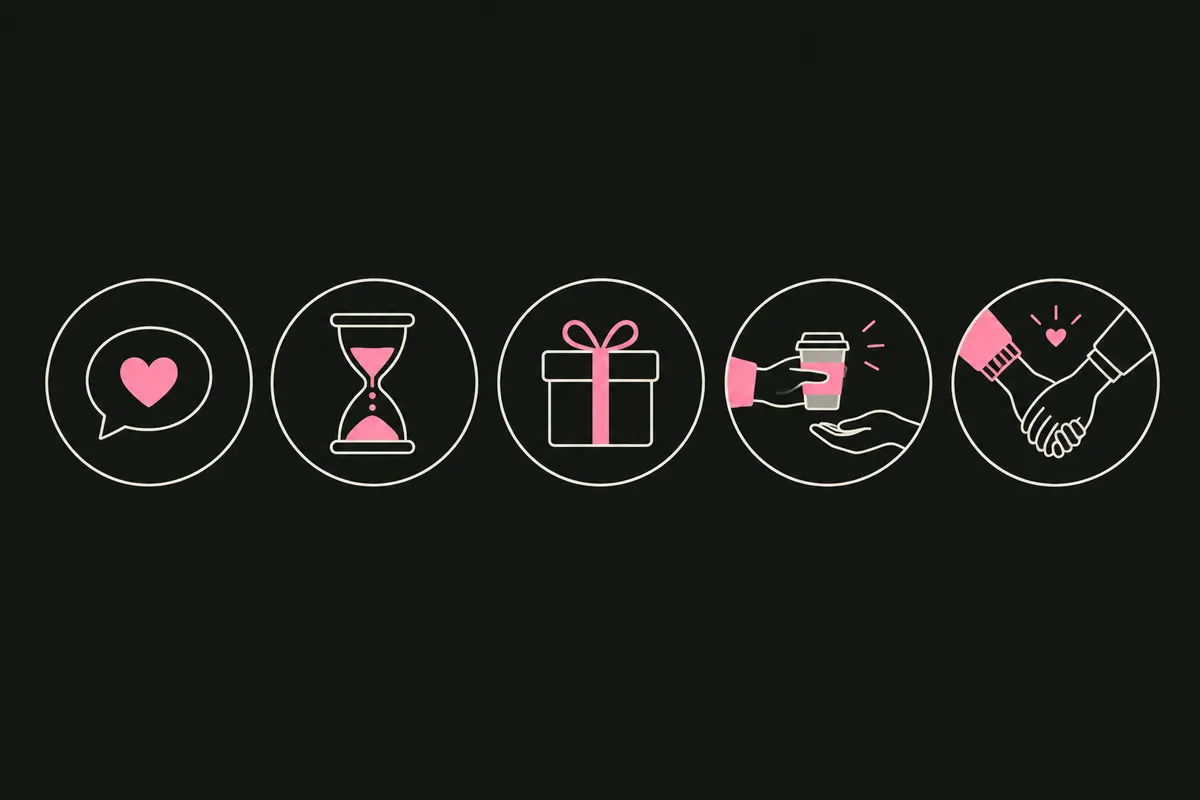
The idea of love languages says that people tend to express and feel love in five main ways: words of affirmation, quality time, receiving gifts, acts of service and physical touch. Most of us value all five, but one or two usually land harder than the rest. The same kind sentence may barely register with one person and stay with another for a week.
This love language test measures how much each of the five matters to you. Its 30 statements, six per language, cover both sides of love: what makes you feel cared for and how you naturally show care. They also reach beyond romance, with statements about partners, family and friends, because the same patterns often show up in all three kinds of relationship.
02
Where the idea of love languages comes from
The love languages were introduced by Gary Chapman, an American pastor and marriage counselor, in a book published in 1992. After years of counseling couples, he noticed that many partners felt unloved even when the other person was trying hard. Often each one was showing love in the way they wanted to receive it, and the message simply was not getting through.
The book became a long-running bestseller, and Chapman and co-authors later applied the same five languages to children, teenagers and the workplace. The phrase has since entered everyday speech, and people now compare love languages on dates, in group chats and at family dinners. This love language test uses the five categories of that model, with original statements written for this site.
03
The five love languages in plain words
Words of affirmation means feeling loved through what people say or write: compliments, encouragement, thanks and plain statements like “I'm proud of you.” Quality time means undivided attention: a real conversation, a shared walk, an evening with the phones put away. Receiving gifts is about the thought a present carries, not its price, so a pebble brought back from a beach trip can count as much as anything from a store.
Acts of service means feeling loved when someone makes your life easier: cooking dinner, fixing the bike, taking a task off your plate. Physical touch means feeling close through hugs, holding hands, a hand on the shoulder or sitting side by side. Each language also has its own way of being hurt, from harsh words to canceled plans, forgotten birthdays, broken promises or a partner who pulls away.
04
How the love language test scores your answers
Each statement uses a five-point scale from strongly agree to strongly disagree, and the statements appear in a mixed order. When you finish the love language test, each of the five languages gets a score from 0 to 100%: the share of the maximum you could reach on its six statements. Answering neutral to everything would put every language at exactly 50%.
These scores are not percentiles. A score of 70% does not mean you scored higher than 70% of people; it means you agreed fairly strongly with that language's statements. Your highest score is named as your top love language, and the other four are listed in order, so you can see whether one language clearly leads or two or three sit close together.
05
How to read and use your love language test results
Look at the gaps between scores, not just the label. If your top language leads by twenty points, it is probably a clear signal. If three languages sit within a few points of each other, you value them about equally, and the more useful question is which one you miss most when life gets busy. Your love language test result describes what tends to land, not a rule.
The result becomes most useful when you share it. Ask a partner, a close friend or a family member to take the love language test too, then compare. Many people discover that they give love in their own language and wonder why it goes unnoticed. Knowing the other person's top language turns vague effort into specific gestures they will actually feel.
Your lowest score matters too. It does not mean you dislike that kind of care; it means it rarely makes you feel loved on its own. If someone close to you leans heavily on your lowest language, that gap can explain years of small misunderstandings, and naming it often brings quick relief to both of you.
06
What research says, and related tests
The love languages are hugely popular, but they have had less scientific testing than many people assume, and the findings so far are mixed. Some relationship researchers argue that most people value all five forms of care, and that responding to what someone needs in the moment matters more than matching one fixed language. That is a good reason to treat your love language test result as a starting point.
If you enjoy this test, other tests on this site look at different parts of you. The Big Five test measures five broad personality traits and has the strongest research support of any personality model. The Enneagram test looks at core motivations and fears. Taking more than one gives you a richer picture than any single result, and comparing them with someone close can spark good conversations.
The 5 types

Words of Affirmation
If words of affirmation is your top love language, what people say to you carries real weight. A specific compliment, a thank-you text or a quiet “I believe in you” before a hard day can keep you going for a long time. You are often generous with encouragement yourself, and you remember kind sentences for years. The flip side is that criticism, sarcasm or long silences can cut deep. You feel most loved when affection is spoken out loud, not just assumed.

Quality Time
If quality time is your top love language, attention is the gift that matters most. A walk where the other person is fully present, a long dinner or a phone call with no multitasking makes you feel chosen. You tend to show love by making time, even when your schedule is full. Distracted company, constant phone checking and canceled plans can feel like a message that you are not a priority. You feel most loved when someone sets time aside and really shows up.

Receiving Gifts
If receiving gifts is your top love language, a thoughtful present tells you that someone kept you in mind while you were apart. The price matters far less than the thought: a snack you once mentioned, a postcard, a book picked with you in mind. You probably choose gifts carefully yourself and keep the small objects people give you. A forgotten occasion or a careless, last-minute present can hurt more than others realize. You feel most loved when care takes a form you can hold.

Acts of Service
If acts of service is your top love language, you feel cared for when people make your load lighter. Someone handling a dreaded errand, cooking when you are exhausted or fixing what has been broken for weeks says more to you than a speech. You tend to show love the same way, often quietly and without being asked. Broken promises, slacking on shared tasks or help that creates more work can feel like a lack of care. You feel most loved when someone's effort shows up in your day.

Physical Touch
If physical touch is your top love language, closeness is how you feel connected and safe. A long hug, holding hands on a walk, a hand on your back in a crowded room or sitting close on the couch can calm you faster than words. You probably reach out physically with people you trust, always within their comfort. Coldness, pulling away or long stretches without affection can leave you feeling alone, even in company. You feel most loved through warm, welcome contact.
Love Language Test: frequently asked questions
Is this love language test free and private?
Yes. The test is completely free, with no account, email or sign-up. Your answers are scored inside your browser and are never sent anywhere, so nobody else sees how you responded. You can retake it as often as you like, for example after a new relationship or another big change in your life.
How long does the love language test take?
There are 30 statements, and most people finish in about five minutes. Go with your first honest reaction instead of thinking about one special day or one particular person. The test works best when you answer for how you usually are across your closest relationships.
Is this the official quiz from the book?
No. The 5 Love Languages is a registered trademark, and this test is independent: it is not affiliated with or endorsed by Gary Chapman or his publisher. The book's own quiz asks you to choose between pairs of statements. This one uses original statements written for this site, each rated on its own agree-disagree scale.
Can couples take the love language test together?
Yes, and it is one of the best ways to use it. Take it separately, without discussing your answers, then compare your results side by side. Look at each other's top language and lowest one. The lowest often explains why some well-meant efforts go unnoticed, while the top one shows where small gestures count most.
What if two love languages score almost the same?
That is common. Close scores mean your answers do not clearly favor one language, and many people have two that matter about equally. An exact tie is listed in the test's fixed order, so read both descriptions and ask which one you miss most when it is absent. That one is often the more telling.
Does the test work for family and friendships too?
Yes. The statements cover partners, family members and friends, so you can take it whether or not you are in a relationship. You may notice that your love language looks a little different with a parent than with a partner. If so, answer for the pattern that feels most true overall.
How accurate is the love language test?
This love language test is a free self-report tool for self-reflection, not a clinical, diagnostic or couples-therapy instrument. Research on the love languages is limited and mixed. Your scores reflect how you answered today and can shift with mood or circumstances, so treat your result as a conversation starter rather than a fixed fact about you.
Can my love language change over time?
It can. What you need often shifts with life stages: a new parent may suddenly value acts of service, and someone in a long-distance relationship may crave time or touch. If you retake the test after a big change and get a different result, both results can be true for their moment.
What do I get with my love language test result?
Your free result shows your score on all five love languages, names your top language and describes each one in a few lines. If you want to go further, a detailed PDF report is available for your result, with practical ideas on what lands, what to avoid and how to ask for what you need.
More free tests
- Big Five50 statements · about 7 min
- 16 Types48 statements · about 7 min
- Enneagram54 statements · about 8 min
- DISC32 statements · about 5 min
- HEXACO60 statements · about 9 min
- Dark Triad27 statements · about 4 min
- Introvert or extrovert24 statements · about 3 min
- Attachment style32 statements · about 5 min
- Love styles30 statements · about 4 min
- Locus of control24 statements · about 3 min
- Reaction timePlays in your browser · about 1 min
- Typing testPlays in your browser · about 1 min
- Number memoryPlays in your browser · about 1 min
- Verbal memoryPlays in your browser · about 1 min
- Sequence memoryPlays in your browser · about 1 min
- Visual memoryPlays in your browser · about 1 min
- Chimp testPlays in your browser · about 1 min
- Aim trainerPlays in your browser · about 1 min
- 12 Axes36–288 statements · 12 axes · about 5–40 min
Statements: Original items written for this site, based on Gary Chapman's five love languages, © 12axestest.dev.
Love Language Test: How Do You Give and Receive Love?
Start the love language test