Personality tests
Enneagram Test: Which of the Nine Types Fits You?
This free Enneagram test asks you to rate 54 short statements and scores you on all nine Enneagram types. Your Enneagram test result shows your likely type, your wing and how close the other types came. Most people finish in under ten minutes, there is no account to create, and your answers never leave your browser.
- Statements
- 54
- Types
- 9
- Minutes
- 8
01
What the Enneagram test measures
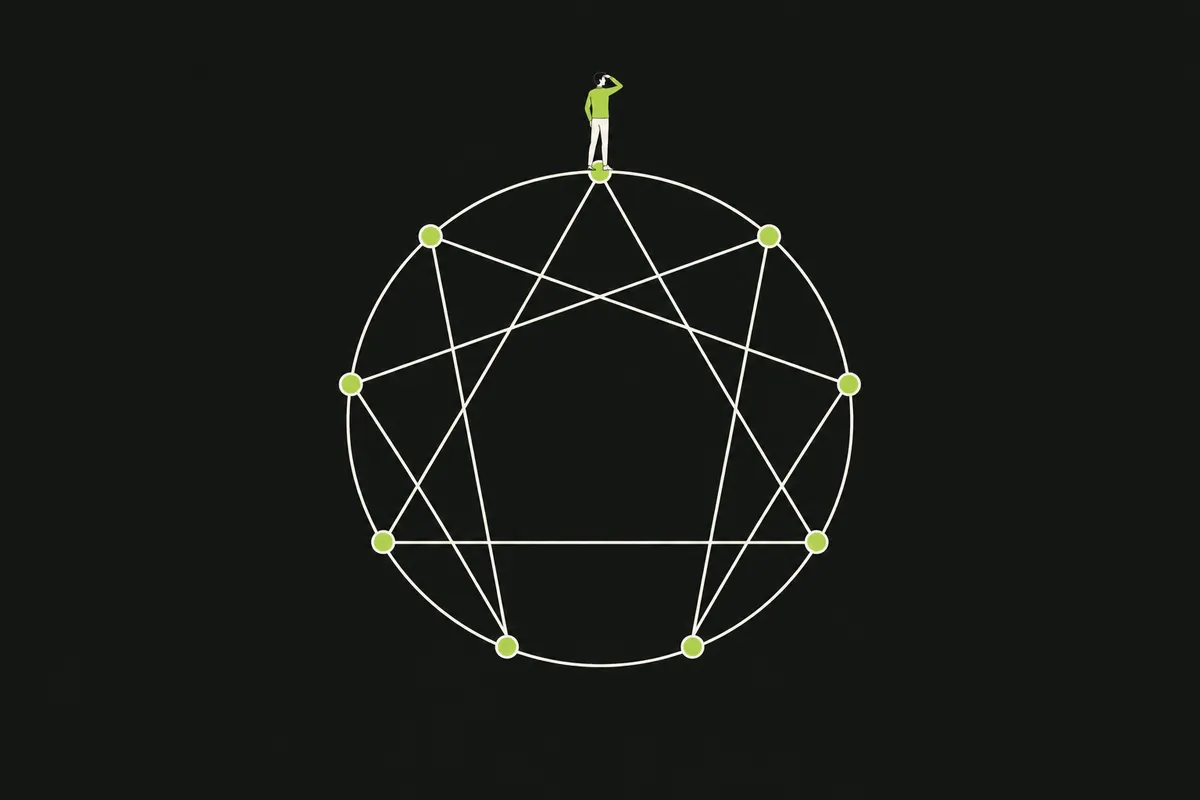
The Enneagram describes nine personality types, numbered 1 to 9 and arranged around a circle, and an Enneagram test looks for the one that fits you best. Each type is defined less by what you do than by why you do it: a core desire that pulls you forward and a core fear you try to avoid. Two people can both stay late at work, one to feel successful and the other to feel safe, and land in different types.
This Enneagram test focuses on those motivations. Its 54 statements, six for each type, ask about what you want, what worries you and how you react when life gets hard. Agreeing with a statement raises the type it belongs to. At the end, you get a score for all nine types, so you see the whole pattern instead of a single label.
02
Where the Enneagram comes from
The nine-pointed Enneagram symbol was taught in the early twentieth century by the spiritual teacher G. I. Gurdjieff, though he did not use it to describe personality types. The personality system most people know today is usually traced to Oscar Ichazo, a Bolivian-born teacher, and Claudio Naranjo, a Chilean psychiatrist, who developed and taught it in the 1960s and 1970s.
Naranjo brought these ideas to the United States, where his students and later authors turned them into the popular books and workshops of the 1980s and 1990s. You may read that the Enneagram is thousands of years old, but there is little evidence for that. This Enneagram test uses the modern nine-type system, best seen as a recent blend of older spiritual ideas and twentieth-century psychology.
03
The three centers: gut, heart and head
Enneagram teachers group the nine types into three centers of three types each. Types 8, 9 and 1 form the gut or instinctive center, often linked with anger and a concern for autonomy. Types 2, 3 and 4 form the heart or feeling center, often linked with shame and a concern for image and connection. Types 5, 6 and 7 form the head or thinking center, often linked with fear and a concern for security.
The centers give you a quick first way to read your Enneagram test results. If your three highest scores all sit in one center, that theme probably runs strongly through your life. If they are spread across centers, look at what your top type and its runners-up have in common before deciding which description really fits.
04
How this Enneagram test scores your answers
Each statement uses a five-point scale, from strongly agree to strongly disagree, and the statements appear in a mixed order so it is hard to tell which type each one belongs to. When you finish the Enneagram test, every type gets a score from 0 to 100%, based on how strongly you agreed with its six statements. Your highest score is your likely type: a starting point, not a verdict.
Your Enneagram test result also shows your wing, which is whichever of the two types beside yours on the circle scored higher. If your top type is 4 and type 5 beats type 3, your result reads 4w5. Wings add flavor to the main type: a 4w5 tends to be more private and reflective, while a 4w3 is usually more expressive and outgoing.
When two or three types land within a few points of each other, the questionnaire is telling you it cannot separate them cleanly from your answers. That is useful information, not a failure. Read those descriptions side by side, pay most attention to each core fear, and ask which one has quietly shaped your choices for years.
05
How to read and use your Enneagram test results
Start with motivation, not behavior. When you open your Enneagram test results, read the description of your top type and ask whether its core desire and fear describe what really drives you, especially under pressure. Many people recognize themselves most clearly in the stress part of a description, because that is when habits show most plainly. If it doesn't fit, read your second type.
Then use your Enneagram test result as a vocabulary for reflection. Notice when your type's typical reaction kicks in, talk it over with someone who knows you well and see whether they agree. The Enneagram is most useful as a prompt for honest conversations and small changes, not as a box you have to live in or an excuse for unkind behavior.
06
Enneagram test vs Big Five and 16 types
People often take an Enneagram test alongside a Big Five or 16-type test, and the three look at different things. The Big Five measures five broad traits on continuous scales and grew out of decades of research on how people describe personality in everyday language; it has by far the strongest scientific support. Sixteen-type tests sort people by four preferences based on Carl Jung's ideas, such as introversion versus extraversion.
The Enneagram asks a different question: what motivates you, and what you try to avoid. It is rich and memorable, but it has far less research behind it than the Big Five, and studies of its reliability are limited. That does not make it worthless; it makes this Enneagram test a tool for self-reflection rather than a measurement to take on faith. Many people enjoy taking all three and comparing.
The 9 types

Type 1: The Perfectionist
Type 1s want to be good, fair and correct, and they fear being wrong, careless or morally off track. A strong inner critic measures every effort against a clear sense of how things should be. At their best they are principled, reliable and generous with their standards, improving whatever they touch without preaching. Under stress the critic gets louder: they turn rigid, impatient and quietly resentful, finding fault with themselves and others. Growth often comes from accepting that good enough is sometimes truly good.

Type 2: The Helper
Type 2s want to be loved and needed, and they fear being unwanted or unworthy of care. They read feelings quickly and often know what someone needs before it is said. At their best they are warm, generous and supportive with no strings attached, and people feel truly seen around them. Under stress they may give in order to be appreciated, ignore their own needs and feel hurt when their efforts go unnoticed. Growth often comes from asking for help as freely as they offer it.

Type 3: The Achiever
Type 3s want to feel valuable and successful, and they fear being seen as worthless or as a failure. They are goal-focused, adaptable and quick to read what a situation rewards. At their best they are energetic, effective and inspiring, helping others believe that ambitious goals are within reach. Under stress they over-identify with their image, work nonstop, push feelings aside and show a polished version of themselves instead of the real one. Growth often comes from realizing they are worth something apart from what they achieve.

Type 4: The Romantic
Type 4s want to find and express a true, unique identity, and they fear being ordinary or having no real significance. They are tuned in to feelings, beauty and what is missing, and often feel different from the people around them. At their best they are creative, emotionally honest and able to stay with others in painful moments without looking away. Under stress they withdraw into their moods, compare themselves unfavorably with others and feel misunderstood. Growth often comes from valuing what is already present in their lives.

Type 5: The Observer
Type 5s want to be capable and to understand how things work, and they fear being helpless, intruded upon or overwhelmed. They protect their time and energy and like to think before they engage. At their best they are clear-thinking, curious and independent, seeing patterns others miss and offering calm, well-informed advice. Under stress they pull away, hold tightly to their resources and overthink instead of acting. Growth often comes from trusting that they already know enough to step into life before feeling fully prepared.

Type 6: The Loyal Skeptic
Type 6s want security and dependable support, and they fear being left without guidance or a safe footing. They are alert to risk and good at spotting what could go wrong. At their best they are loyal, responsible and surprisingly brave: the friend or colleague who prepares for problems and stands by the group. Under stress anxiety takes over, and they may doubt everyone, swing between seeking reassurance and pushing back against authority, and struggle to decide. Growth often comes from trusting their own judgment.

Type 7: The Enthusiast
Type 7s want to be satisfied and free, with plenty of options, and they fear being trapped in pain, boredom or limitation. They are quick, curious and full of plans for what comes next. At their best they are joyful, generous and versatile, bringing optimism and fresh ideas that lift everyone around them. Under stress they scatter their energy, stay busy to avoid uncomfortable feelings and take on more than they can finish. Growth often comes from staying with one thing, including a difficult emotion, long enough to find deeper satisfaction.

Type 8: The Challenger
Type 8s want to protect themselves and stay in control of their own lives, and they fear being harmed or controlled by others. They are direct, energetic and quick to take charge. At their best they are generous protectors who use their strength for people who need it: fair-minded, decisive and loyal. Under stress they become domineering and confrontational, hide any softness and push harder when they sense weakness or betrayal. Growth often comes from realizing that letting trusted people see their vulnerable side is a form of strength.

Type 9: The Peacemaker
Type 9s want inner peace and harmony with others, and they fear conflict and disconnection. They can see every point of view and are often the calming presence in a group. At their best they are accepting, patient and steady, able to bring people together and help them really listen. Under stress they go numb, avoid decisions, put off what matters and resist quietly instead of saying what they want. Growth often comes from recognizing that their own wishes matter, and that voicing them can deepen connection.
Enneagram Test: frequently asked questions
Is this Enneagram test really free?
Yes. It is completely free, with no account, email or sign-up. Your answers are scored in your browser and never leave it, so nobody else sees how you responded. You can retake it as often as you like and compare your results over time.
How long does the Enneagram test take?
The Enneagram test has 54 statements, and most people finish in under ten minutes. Go with your first honest reaction rather than weighing each statement for a long time. Overthinking tends to pull your answers toward the person you wish you were.
What does a wing like 4w5 mean in my Enneagram test result?
On this Enneagram test, your wing is whichever neighboring type on the circle scored higher. Each type has two neighbors: type 4 sits between 3 and 5, and type 9 sits between 8 and 1. A 4w5 is a type 4 with a noticeable type 5 flavor. A wing shades your main type rather than replacing it.
Does the Enneagram test measure subtypes or instincts?
No. Many Enneagram teachers describe three instinctual variants, often called self-preservation, social and one-to-one, that shape how each type shows up in daily life. This Enneagram test scores only the nine types and your wing. Once you feel fairly sure of your main type, reading about the instincts can add useful detail.
What if two types score almost the same on my Enneagram test?
That is common. Close scores mean your answers do not clearly separate those types. Read the descriptions of your top two or three types and focus on the core fear, which tends to be more telling than behavior. Asking a friend which one sounds like you can also help.
How accurate is the Enneagram test?
The Enneagram has much less research support than models like the Big Five, and studies of its reliability are limited. This Enneagram test is a free self-report tool for self-reflection, not a clinical, diagnostic or hiring instrument. Treat your result as a hypothesis to explore, and trust your own judgment over any score.
Can my Enneagram type change over time?
Your scores on an Enneagram test can shift, especially during a hard period or a big life change. Most Enneagram teachers say your basic type stays the same, while how healthily you express it changes with growth and stress. If your result changes, read both types and ask which core motivation has stayed constant.
Should I answer as I am or as I want to be?
The Enneagram test works best when you answer as you usually are across most of your life, not as you behave on your best day or as you think you should be. If a statement fits you at work but not at home, pick the answer that is true most of the time. Neutral is fine when you are truly unsure.
Is any Enneagram type better than the others?
No. Every type has typical strengths and typical blind spots, and each one can be healthy or struggling. The Enneagram test does not rank people, and no type is kinder or smarter by nature. The point is to understand your own patterns, not to aim for the type that sounds most appealing.
More free tests
- Big Five50 statements · about 7 min
- 16 Types48 statements · about 7 min
- DISC32 statements · about 5 min
- HEXACO60 statements · about 9 min
- Dark Triad27 statements · about 4 min
- Introvert or extrovert24 statements · about 3 min
- Attachment style32 statements · about 5 min
- Love language30 statements · about 4 min
- Love styles30 statements · about 4 min
- Locus of control24 statements · about 3 min
- Reaction timePlays in your browser · about 1 min
- Typing testPlays in your browser · about 1 min
- Number memoryPlays in your browser · about 1 min
- Verbal memoryPlays in your browser · about 1 min
- Sequence memoryPlays in your browser · about 1 min
- Visual memoryPlays in your browser · about 1 min
- Chimp testPlays in your browser · about 1 min
- Aim trainerPlays in your browser · about 1 min
- 12 Axes36–288 statements · 12 axes · about 5–40 min
Statements: Original items written for this site, based on the nine Enneagram types, © 12axestest.dev.
Enneagram Test: Which of the Nine Types Fits You?
Start the Enneagram test