Brain tests
Visual Memory Test: Remember the Squares
This visual memory test checks how many squares you can hold in mind after a single glance. A pattern lights up on the grid for 1.2 seconds, then goes dark, and your job is to tap the same squares as the pattern grows level by level.
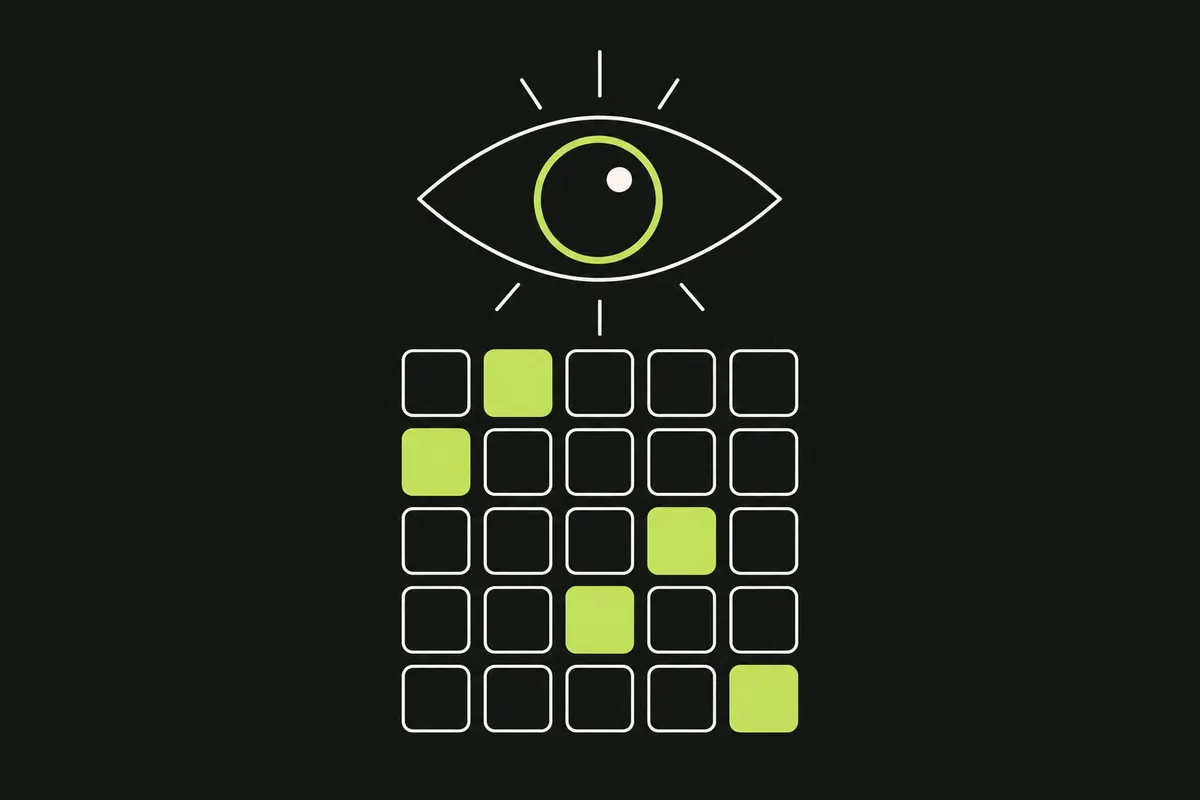
Remember the squares
A few squares light up for a moment. When they go dark, tap the same squares. Each level adds one square and the grid grows. Three wrong squares cost a life, and you have 3 lives.
Your results stay in this browser. Nothing is sent to a server.
01
How the visual memory test works
Each level starts with a grid of dark squares. A few of them light up for 1.2 seconds, then the whole grid goes dark again. Your job is to tap the squares that were lit, in any order you like. Every correct tap lights its square back up, and every wrong tap is marked so you can see exactly where you missed.
Level 1 shows 3 squares on a 3×3 grid, and each new level adds one more, so level 5 has 7 squares and level 10 has 12. The grid grows too: 3×3 for levels 1 to 3, 4×4 for levels 4 to 6, 5×5 for 7 to 9, 6×6 for 10 to 12, 7×7 for 13 to 15 and 8×8 from level 16 on. A bigger grid gives the pattern more room to spread out.
You have 3 lives. If you tap three wrong squares in one level, you lose a life and the same level starts again with a new pattern, so you never replay one you have already seen. When the last life is gone, the visual memory test ends and shows your score. The rules are simple enough for kids, the later levels challenge adults, and your best score is saved on this device.
02
What your visual memory test score means
Your score is the highest level you completed, or 0 if you did not clear any. Because each level adds one square, the number tells you directly what you remembered: a score of 5 means you recalled 7 squares at once on a 4×4 grid, and a score of 10 means 12 squares on a 6×6 grid.
The result falls into one of five bands: 0 to 3, 4 to 6, 7 to 9, 10 to 13, and 14 or more. The first bands roughly follow the grid sizes, so 0 to 3 keeps you on the small 3×3 board, 4 to 6 covers the 4×4 board and 7 to 9 the 5×5. Each band comes with a short note and a tip for your next attempt.
This visual memory test does not publish averages or rank you against anyone else. The bands describe what you did here, nothing more. The most useful comparison is with yourself: the same device, a similar time of day, a few attempts, and your best score as the bar to clear.
03
Visual working memory: the science behind the squares
Holding a picture in mind for a few seconds relies on what psychologists call visual working memory, a short-term store for shapes, colors and locations. In the working memory model that Alan Baddeley and Graham Hitch proposed in 1974, this job belongs to a component usually called the visuospatial sketchpad, which works alongside a separate system for words and sounds.
That store is small. In a widely cited 1997 study, Steven Luck and Edward Vogel found that people could keep only a few simple objects in visual working memory at once, often estimated at around three or four. So how can anyone remember a dozen lit squares? Mostly by not treating them as a dozen separate items. People tend to bind nearby squares into lines, corners and blocks, so the whole pattern becomes a handful of shapes.
Grid tasks have a long history in memory research. The Corsi block-tapping task, developed by Philip Corsi in the early 1970s, asks people to touch blocks scattered on a board in the same order the examiner did. This game works differently: all the squares appear at the same moment and you can tap them in any order, so it leans on remembering a whole layout rather than a path.
04
Photographic memory: myth vs reality
Many people look for a visual memory test hoping to find out whether they have a photographic memory, the ability to recall a scene in perfect detail as if looking at a photo. Researchers have found little solid evidence that adults have anything like that. A related idea, eidetic imagery, has been reported in a small number of children, but those images tend to fade quickly and are less exact than the name suggests.
What does exist is sharp short-term visual memory, especially with practice and a good strategy. In a well-known 2007 study at Kyoto University's Primate Research Institute, Sana Inoue and Tetsuro Matsuzawa reported that a young chimpanzee named Ayumu could recall the positions of numbers flashed on a screen for a fraction of a second, doing better than the university students tested on that task. Researchers still debate what the result means, but it shows how much a brief glance can hold.
05
How to improve your visual memory test score
The biggest gain comes from seeing the pattern as a shape. Instead of memorizing seven separate squares, notice that three of them form an L, two sit side by side in a corner and two make a diagonal. A few shapes are much easier to hold through the moment between the flash and your first tap than a long list of positions.
Grouping matters more as the grid grows. On the 5×5 board and beyond, split the grid into halves or quarters in your mind and remember what each part looks like. While the pattern shows, keep your eyes resting on the center of the board instead of darting from square to square, because 1.2 seconds goes by quickly. When you start tapping, do the biggest cluster first while it is fresh, then the squares that stand alone.
Use your lives wisely. Two wrong taps in a level are allowed before the third costs a life, so tap the squares you are sure of first and leave the doubtful ones for last. Play when you feel rested and keep sessions short. Your score tends to climb as the task becomes familiar and then levels off, which is completely normal.
06
Why your visual memory test score changes
Scores move around from one attempt to the next. Some patterns happen to form neat shapes while others scatter across the grid, and one lapse of attention during the 1.2-second flash can cost you a life. Tiredness, distraction and screen size play a part too, so treat each run as a snapshot and watch your best score over several sessions.
This visual memory test is a free practice game. It is not a medical, clinical or IQ test, it is not a hiring test, and it is not the psychological exam some countries require for a driver's license. It is not a clinical tool like the Benton Visual Retention Test either. If you or someone close to you notices changes in memory that worry you, talk to a doctor, who can arrange a proper assessment.
Visual Memory Test: frequently asked questions
What is a good visual memory test score?
There is no official cutoff, and this test does not compare you with other players, so a good score is one that beats your last best. As a guide, finishing level 6 means you recalled 8 squares on the 4×4 grid, and reaching 10 means you held 12 squares on a 6×6 grid.
What is the average score on a visual memory test?
This page does not show an average, because it never collects anyone's results: the game runs entirely in your browser. Averages from other tests would not carry over anyway, since the flash time, grid size and rules change the numbers a lot. Use the five bands and your own best score as your reference.
How accurate is an online visual memory test?
It is a consistent way to track your own short-term memory for patterns, because the rules and the 1.2-second flash never change. It is not a precise measurement, though. A single run depends on attention, how the squares happen to fall and your screen, so several attempts on the same device give a fairer picture.
Is it better to play on a phone or a computer?
The game works on both. A bigger screen makes the squares larger, while a phone keeps the whole grid close to the center of your vision. Tapping a touchscreen is about as quick as clicking, so pick whichever feels comfortable and compare results on the same device.
Do I have to tap the squares in the right order?
No. All the squares light up at once, and you can tap them in any order. Correct taps light up again and wrong ones are marked. Two mistakes in a level are allowed; the third costs a life and restarts that level with a new pattern.
Can memory games and exercises improve my score?
Your score here usually rises with practice as you learn to see shapes and group squares, and then it levels off. That means you got better at this task. There is little solid evidence that gains on memory games carry over to everyday memory, so enjoy it as a game and a way to track yourself.
Is this visual memory test a medical, IQ or driving test?
No. It is a free practice game, not a medical, clinical or IQ assessment, and not the psychological exam required for a driver's license in some countries. It does not replace clinical tools like the Benton Visual Retention Test. If you are worried about changes in your memory, a doctor is the right person to talk to.
Is it free, and is my data stored?
It is free, with no sign-up. The game runs in your browser and nothing is sent to a server. Only your best score is kept, in this browser's storage on this device, and clearing the site data for this page removes it.
More free tests
- Big Five50 statements · about 7 min
- 16 Types48 statements · about 7 min
- Enneagram54 statements · about 8 min
- DISC32 statements · about 5 min
- HEXACO60 statements · about 9 min
- Dark Triad27 statements · about 4 min
- Introvert or extrovert24 statements · about 3 min
- Attachment style32 statements · about 5 min
- Love language30 statements · about 4 min
- Love styles30 statements · about 4 min
- Locus of control24 statements · about 3 min
- Reaction timePlays in your browser · about 1 min
- Typing testPlays in your browser · about 1 min
- Number memoryPlays in your browser · about 1 min
- Verbal memoryPlays in your browser · about 1 min
- Sequence memoryPlays in your browser · about 1 min
- Chimp testPlays in your browser · about 1 min
- Aim trainerPlays in your browser · about 1 min
- 12 Axes36–288 statements · 12 axes · about 5–40 min
Visual Memory Test: Remember the Squares
Play now