Brain tests
Sequence Memory Test: Watch the Lights, Repeat the Pattern
This sequence memory test lights up tiles one after another on a 3×3 grid, and you tap them back in the same order. Each level adds one step to the pattern, and your score is the longest sequence you repeat without a mistake.
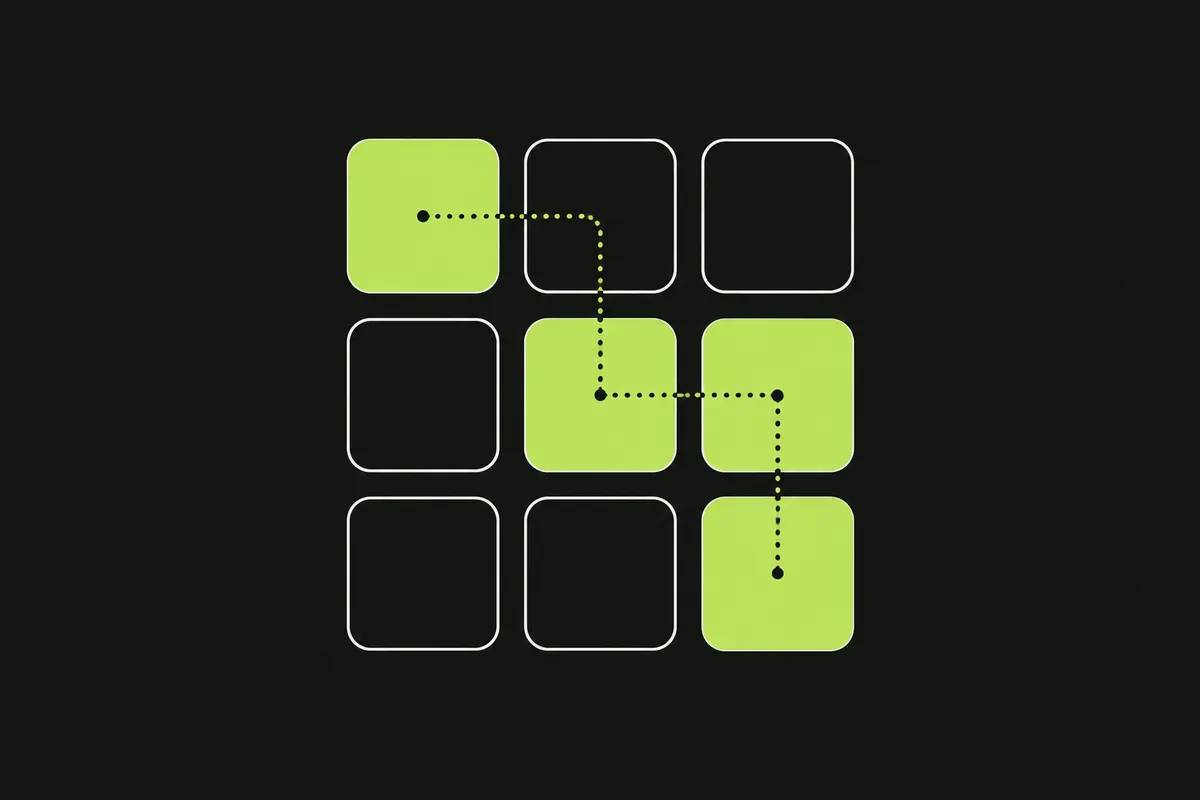
Repeat the pattern
Tiles light up one after another. Watch, then tap them in the same order. Every level replays the whole pattern with one more step, and one wrong tile ends the run.
Your results stay in this browser. Nothing is sent to a server.
01
How the sequence memory test works
The board is a 3×3 grid of nine tiles. Press Start and watch: on level 1, one tile lights up and you tap it. On level 2, that same tile lights up again, followed by a new one, and you tap both in order. Every level of the sequence memory test replays the whole pattern from the beginning and adds one more step at the end, so the sequence you have to hold grows by exactly one tile.
Each tile stays lit for about half a second, with a short gap before the next one, and the grid does not accept taps while the pattern is playing. When the label changes from Watch to Your turn, tap the tiles in the order you saw them. The same tile never lights twice in a row, but it can come back later in the pattern, so longer runs often return to a corner you already visited.
One wrong tile ends the run. There are no extra lives, which keeps the result simple: your score is the length of the longest pattern you repeated correctly. You can play with a mouse, with your finger on a touchscreen, or with the keyboard, pressing Tab to move between tiles and Enter or Space to choose one.
02
What your sequence memory test score means
Your score counts steps. If you clear level 7 and then miss a tile on level 8, you repeated a seven-step pattern, so your score is 7. If the very first tile goes wrong, the score is 0. Speed plays no part, only how long a pattern you carried in the right order. Your best score is saved on this device, so you can try to beat it next time.
Each result falls into one of five bands: 0 to 4 steps, 5 to 7, 8 to 10, 11 to 14, and 15 or more. The text for each band describes what that length of pattern looks like in this sequence memory game and suggests one thing to try on your next run. The bands describe your attempt; they do not rank you against other people, and this page has no data to do that with anyway.
Read any single score as a snapshot. The pattern is random each time and one slip ends the run, so two attempts a minute apart can land several steps apart. Your best shows what you can do on a good run; the scores you reach again and again show your steady level.
03
Where the sequence memory test comes from
Repeating a sequence of locations is a classic task in psychology. The best-known version is the Corsi block-tapping task, usually credited to Philip Corsi, who described it in the early 1970s at McGill University in Canada. In the classic setup, an examiner taps a series of blocks fixed to a board, and the person taps the same blocks in the same order. The sequences get longer until the person can no longer repeat them correctly.
The Corsi task is often described as a spatial counterpart to the digit span tasks used in Wechsler scales, where people repeat lists of numbers. Researchers use it to study spatial working memory, the short-term system that keeps track of where things are. In the influential 1974 model of working memory proposed by Alan Baddeley and Graham Hitch, this kind of information is handled by a part they called the visuospatial sketchpad, separate from a loop that holds words and sounds.
The grow-by-one idea also reached toy shelves. Simon, the electronic game with four colored buttons released in the late 1970s, played a pattern and added one step every round, and many Simon-style games have followed. This page borrows from both, with no claim to be a lab measure.
04
What affects your pattern memory
Attention matters most on a sequence memory test. You have to catch every step as it flashes past, and a single glance away during the replay can cost you a tile you would otherwise have kept. Tiredness, poor sleep, background noise and a buzzing phone all make the pattern harder to hold, which is why the same person can score quite differently in the morning and late at night.
The pattern itself matters too. Sequences that form a clean shape, such as a line along the top row or a loop around the edge, are easier to keep than ones that zigzag across the center or return to the same tile several times. Since every pattern is random, some runs are simply kinder than others. Your device plays a smaller role: on a phone, a finger can land on the neighboring tile, which counts as a mistake even if you remembered the pattern perfectly.
05
How to improve your sequence memory test score
The most useful tip is to give each tile a name. As the pattern plays, say the positions silently in your head, such as top left, center, bottom right, or number the tiles 1 to 9 like a phone keypad and repeat the digits. Turning positions into words lets your verbal memory share the load with your visual memory, and that often makes long patterns easier to keep.
Another approach is to trace the path. Instead of storing separate flashes, picture the sequence as one line moving across the grid, like drawing a shape without lifting your pen. Break long patterns into chunks of three or four steps, such as a corner, a diagonal and a jump back to the middle, and remember the chunks rather than every single tile.
Use the replay to your advantage. Because each level starts from the beginning, the first part of the pattern is the part you already know, so you can check it against what you remember and save your full attention for the new step at the end. When it is your turn, tap at a steady pace; rushing can cost you a tile you actually remembered.
06
Why scores vary, and what this game is not
Sequence memory is not a fixed number. Scores shift with how rested you are, how hard the random pattern is and how warmed up you feel, and because one wrong tile ends the run, a single slip can cut a good attempt short. Playing a few runs and looking at your usual range is a better guide than any one result.
The sequence memory test on this page is a game for fun and self-tracking. It is not a medical, clinical or IQ test, and it cannot diagnose anything about memory or attention. If you or someone close to you has noticed changes in memory that worry you, talk to a doctor, who can look at the full picture with proper tools.
Sequence Memory Test: frequently asked questions
What is a good score on the sequence memory test?
The best yardstick is your own earlier runs. The five bands on this page describe each length of pattern, from 0 to 4 steps up to 15 or more, and a score above your usual is a good result. Because patterns are random, judge yourself on several runs rather than one.
Is there an average sequence memory score?
This page does not publish one, because it does not collect anyone's results; your score never leaves your browser. Research versions such as the Corsi block-tapping task use different boards, timings and rules, so their numbers would not transfer to this game anyway. Comparing your own runs on the same device is the fairest measure.
How accurate is an online sequence memory test?
It accurately records the longest pattern you repeated in that run, but a single run depends a lot on the random pattern and on one slip. Several runs give a much steadier picture. It is a game version of a classic task, not a standardized lab measure, so treat it as a personal benchmark.
Is it easier on a phone or a computer?
The pattern works the same way on both, but on a small screen a finger can land on the neighboring tile and end a run you had remembered. A mouse or the keyboard, with Tab and Enter or Space, usually makes those slips rarer. For fair comparisons, stick to one device.
Can I improve with practice?
Usually, yes, mostly because you get better at the game itself: naming tiles, tracing paths and chunking the pattern. Those gains show that strategies work on this task; they are not proof of a change in your memory in general. Your best is saved on this device, so you can see how your runs develop.
How is this different from a Simon-style game?
The core idea is the same: watch a pattern, repeat it, and get one more step each round. Simon uses four colored buttons with a tone for each, while this game uses nine tiles on a 3×3 grid and no sound, so position is your only clue. More tiles give the pattern more places to go.
Is the sequence memory test a medical or IQ test?
No. It is a free game for fun and self-tracking, not a medical, clinical or IQ assessment, and it cannot diagnose memory problems. If you are worried about changes in your memory, a doctor is the right person to talk to.
Is it free, and is my data stored?
The sequence memory test is free, with no sign-up. The whole game runs in your browser and nothing is sent to a server. Only your best score is kept, in this browser's storage on this device, and clearing the site data removes it.
More free tests
- Big Five50 statements · about 7 min
- 16 Types48 statements · about 7 min
- Enneagram54 statements · about 8 min
- DISC32 statements · about 5 min
- HEXACO60 statements · about 9 min
- Dark Triad27 statements · about 4 min
- Introvert or extrovert24 statements · about 3 min
- Attachment style32 statements · about 5 min
- Love language30 statements · about 4 min
- Love styles30 statements · about 4 min
- Locus of control24 statements · about 3 min
- Reaction timePlays in your browser · about 1 min
- Typing testPlays in your browser · about 1 min
- Number memoryPlays in your browser · about 1 min
- Verbal memoryPlays in your browser · about 1 min
- Visual memoryPlays in your browser · about 1 min
- Chimp testPlays in your browser · about 1 min
- Aim trainerPlays in your browser · about 1 min
- 12 Axes36–288 statements · 12 axes · about 5–40 min
Sequence Memory Test: Watch the Lights, Repeat the Pattern
Play now