
Public goods vs common resources turns on what happens when another person uses something. A flood warning can reach an additional household without leaving less warning for the first household. A fish removed from a shared lake is no longer available for another fisher to catch. Both situations may make excluding users difficult, but only the second subtracts from a stock available to others.
This distinction concerns the characteristics of a benefit or resource. It does not tell us who owns it, who should pay for it or which organization will manage it best. Those are further questions. A fictional river town, with a warning siren near a lake and boats using the same fish stock, makes the difference easier to follow.
Public goods vs common resources in two questions
The first question is whether it is practical to exclude someone from a benefit. Suppose the town's flood siren can be heard across nearby streets. Once it sounds, preventing a particular household from hearing it would be difficult. We are describing that audible signal within its coverage area, not every component of a flood protection system.
The second question is whether one person's use subtracts from what others can use. Hearing the signal does not consume a portion of it. By contrast, catching a fish removes it from the stock. Future reproduction may replenish fish, but that possibility does not make a present catch non-subtractive.
Elinor Ostrom's Nobel lecture organizes goods using difficulty of exclusion and subtractability of use. Her discussion treats these as characteristics with degrees rather than perfectly fixed opposites. The distinction helps explain why a common-pool resource poses different coordination problems from a public good.
Here, “common resources” refers to common-pool resources in that economic sense. It does not mean that every asset described as shared has identical physical properties or the same rules.
The town's warning signal and fish stock
Imagine that residents want a reliable flood warning. An installed siren needs financing, maintenance and someone authorized to activate it. A household might benefit from the signal whether or not it helped pay. The challenge is to arrange dependable provision when receiving the benefit does not necessarily depend on contributing.
Now consider the lake. In this fictional setting, keeping all unauthorized users away from the fish stock is difficult. Each boat's catch reduces the stock available to other users at that moment. The management problem includes who may harvest, how much they may take and how compliance can be observed.
| Feature | Audible warning signal | Shared lake fish stock |
|---|---|---|
| Excluding users in the example | Difficult within the sound's coverage | Difficult under the assumed access conditions |
| Effect of another person's use | Hearing does not leave less signal for others | Catching fish removes them from the stock |
| Central coordination concern | Financing and reliable provision | Harvesting, access and monitoring |
| What the classification does not decide | Who must operate or fund the siren | Who must own or manage the lake |
Neither column is a complete policy plan. The example supplies no catch totals, maintenance costs, reproduction rates or evidence that one arrangement performs better. It isolates the characteristics that make the problems different.
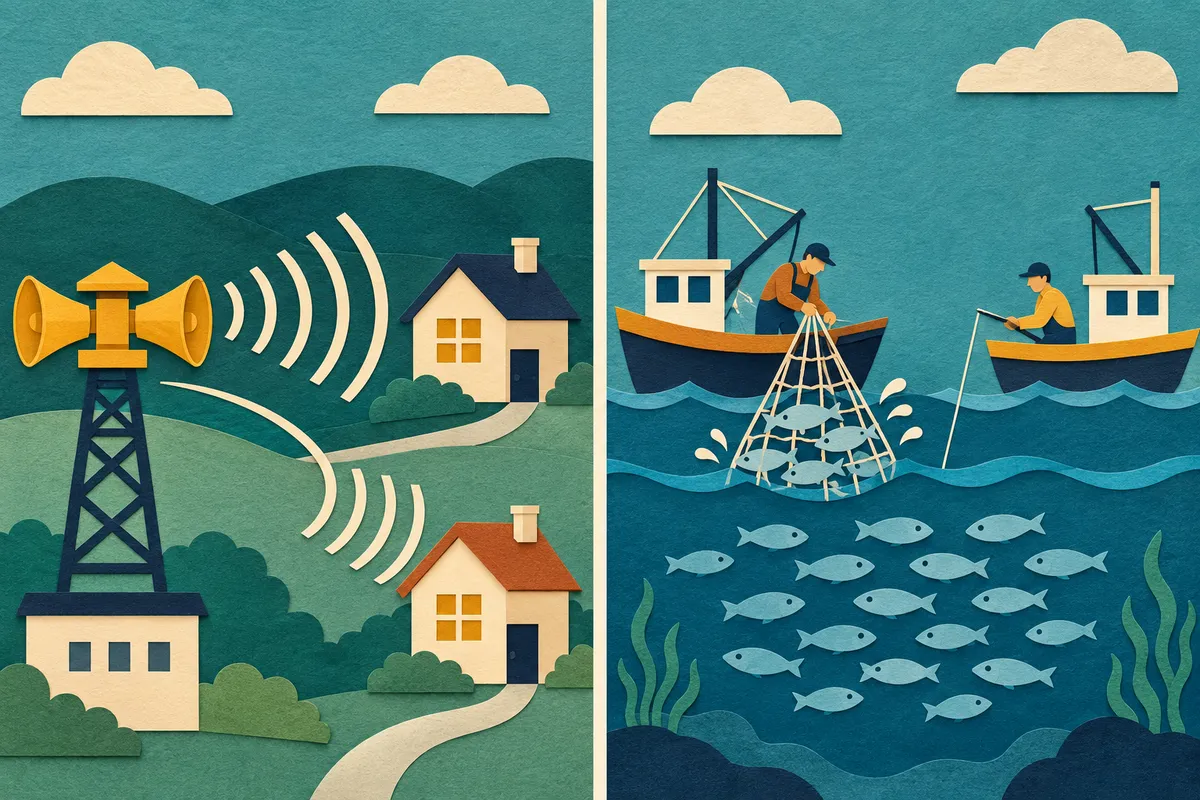
These are conceptual illustrations of an invented town. The boats and fish do not encode measured quantities, and the siren's illustrated reach is not an engineering estimate of real coverage.
Financing is different from managing withdrawals
A discussion of public goods vs common resources should follow the actual decision. For the siren, residents need an arrangement that keeps the service ready before a flood. They might debate public funding, voluntary contributions or another financing method. Naming those options does not establish that each would collect enough money or operate reliably.
For the fish stock, collecting funds may support monitoring, but money alone does not answer the harvesting question. Even a well-funded management office needs workable rules about access and withdrawals. Users must understand what is permitted, and the arrangement needs a way to detect and respond to departures from those rules.
The problems can overlap. A fishery can require shared monitoring services, while a warning system can depend on scarce equipment and staff. It helps to specify which part is being classified. The signal, the device and the labor needed to maintain it are connected, but they are not interchangeable economic objects.
This also explains why calling every shared challenge a “free rider problem” loses information. Benefiting without contributing to provision differs from taking a subtractable resource without respecting harvest rules. An institution designed for one problem may not address the other.
Ownership does not settle the classification
Public ownership, private ownership and shared management describe institutional arrangements. They are not alternative names for the two characteristics in the table. A publicly owned lake still contains fish that can be caught and removed. A privately operated audible siren may still reach people who did not buy access to the signal.
Likewise, a common-pool resource is not necessarily open to everyone without rules. A group may define membership, monitor use and agree on harvesting restrictions. Whether those arrangements are effective requires evidence about their operation. The word “common” does not prove either disorder or successful cooperation.
Ostrom's lecture discusses institutional diversity and challenges simple assumptions that a single form of organization solves every resource problem. That is a reason to examine rules and conditions, not a guarantee that local management always works. Our fictional town has no institutional performance data from which to choose a winner.
Practical exclusion can also change. Access technology or enforceable boundaries may make it easier to restrict use. Congestion can make an extra user matter more. The classification should therefore be tied to the resource, scale and conditions being discussed, rather than treated as a permanent label attached to its owner.
Connecting the example to political preferences
The twelve axes overview separates questions about economic organization, authority and other political preferences. The town's choices might involve several of them: who pays, who writes the rules, who monitors behavior and who can challenge a decision. A description of the resource does not supply all those answers.
Someone could support public funding for the warning signal while preferring fishery rules developed with users. Another person could favor a different division of responsibilities. Neither position follows automatically from knowing that the signal is non-subtractive and the fish stock is subtractable.
The methodology explains how answers become the site's results. Those results summarize expressed preferences; they do not establish the biological condition of a lake or the effectiveness of a funding system. This article assigns no coordinates or scores to the invented town.
To explore your own preferences about shared services, resources and authority, take the 12 Axes test. Keep the physical problem separate from the institutional choice: first identify exclusion and subtractability, then consider the rules and responsibilities needed to address them.