
An electoral threshold is a minimum requirement that determines access to representation or to a stage of seat allocation. In a party-list example, it can require a list to reach a specified share of valid votes before participating in the allocation. Clearing that requirement and calculating seats are different operations.
A useful way to read a rule is to ask which votes determine eligibility, then which votes enter the seat formula. Those totals need not be identical. The worked example below uses invented lists and votes to make that distinction visible, without predicting an election or describing the rules of a particular country.
Electoral threshold: define the denominator and boundary
Imagine one constituency with ten seats and 1,000 valid list votes. Four lists compete: A receives 460 votes, B receives 350, C receives 150 and D receives 40. The fictional rule requires at least 5% of all valid list votes to qualify for the allocation.
Five percent of 1,000 is 50. Because the rule is inclusive, exactly 50 votes would qualify. A, B and C exceed that requirement. D receives 4% and does not meet it. There are no exceptions or alternative routes to qualification in this example.
The denominator is part of the rule, not a detail to fill in later. Here it is all 1,000 valid list votes. We are not using the number of registered voters, ballots issued, eligible lists or seats. A different denominator could produce a different test even if the displayed percentage stayed the same.
| List | Valid votes | Share of original votes | Meets at least 5%? |
|---|---|---|---|
| A | 460 | 46% | Yes |
| B | 350 | 35% | Yes |
| C | 150 | 15% | Yes |
| D | 40 | 4% | No |
| Total | 1,000 | 100% | Three lists qualify |
The electoral threshold has now done its job: it has determined the eligible set. It has not yet said how the ten seats should be distributed. A list's vote share in this table is therefore not its final seat share.
Apply the seat formula only after qualification
For allocation, this invented system uses the votes of eligible lists only. Their total is 460 + 350 + 150 = 960. D's 40 votes still exist in the election total, but they do not enter this stage. We do not redistribute them to a preferred party or infer their voters' second choices.
Use the Hare quota with largest remainders to allocate the ten seats. The quota is 960 divided by ten, or 96 votes per seat. First give each eligible list the whole-number part of its votes divided by 96. A receives four initial seats, B three and C one.
Those initial allocations use eight seats. To assign the two remaining seats, calculate the votes left after the whole quotas: A has 460 − 384 = 76, B has 350 − 288 = 62, and C has 150 − 96 = 54. A and B have the two largest remainders and each receives one additional seat.
| List | Votes used in allocation | Initial seats | Remainder in votes | Extra seat | Final seats |
|---|---|---|---|---|---|
| A | 460 | 4 | 76 | 1 | 5 |
| B | 350 | 3 | 62 | 1 | 4 |
| C | 150 | 1 | 54 | 0 | 1 |
| D | Excluded | 0 | Not applicable | 0 | 0 |
The final allocation is A five, B four, C one and D zero. The seats sum to ten, and the three remainder values are distinct. No tie-breaking rule is needed for this calculation. A different quota, divisor method or qualification rule would require its own calculation.
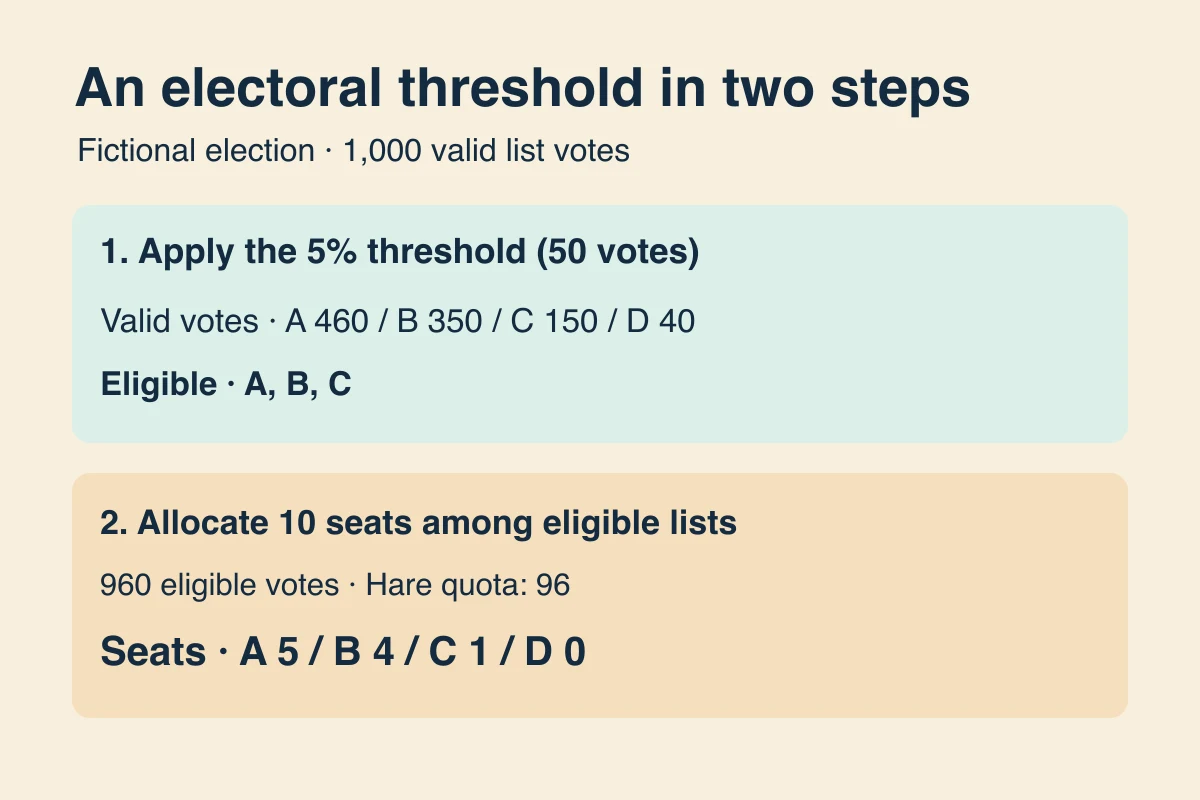
The diagram shows fictional arithmetic, not survey data or a forecast. The cover is a conceptual illustration. Neither image represents actual parties, candidates or an existing legislature.
What the electoral threshold changes in this example
The electoral threshold separates two totals: 1,000 for testing the original vote shares, and 960 for the specified allocation. Testing the threshold again against 960 would change the question. The rule told us to use all valid list votes for eligibility, so that test is completed before the eligible-vote total is calculated.
There is also a distinction between a vote share and a seat share. A's original 46% becomes five of ten seats, or 50%. B's 35% becomes 40% of the seats, while C's 15% becomes 10%. These results follow from both the eligibility restriction and the way indivisible seats are allocated.
It would be inaccurate to say that D's exclusion alone explains every difference between votes and seats. Ten seats cannot express every percentage exactly, and the allocation formula matters. This article does not calculate a counterfactual result without the restriction; doing so would require applying a fully specified alternative, including any necessary tie-breaking procedure.
A formal rule is not the whole obstacle to representation
International IDEA's Electoral System Design handbook discusses formal thresholds and the barriers arising from electoral design, including constituency size. An explicit electoral threshold is a written requirement. The practical level of support needed to win a seat also depends on the number of seats and the allocation method.
That distinction matters even when no percentage appears in a rule. A constituency with very few seats cannot distribute them among unlimited lists. A list can therefore struggle to win representation without having failed an explicit percentage requirement. Conversely, passing a stated requirement does not determine its exact seat entitlement.
Our earlier article on proportional representation and district plurality illustrates how constituency structure changes seat outcomes. Here we keep the constituency fixed and examine eligibility before allocation. The examples answer related but different questions.
An electoral threshold should therefore be read with its surrounding rules: where it applies, how votes are counted, whether exceptions exist and what allocation follows. The label alone does not identify a complete electoral system.
Evaluating an electoral threshold beyond the arithmetic
Debates about an electoral threshold often involve competing priorities: allowing more viewpoints into a legislature and limiting fragmentation among represented groups. The fictional allocation cannot establish which balance is preferable. It shows who qualifies and how seats are distributed under one stated arrangement.
It also holds voting behavior fixed. Voters might respond to a known requirement, and groups might change campaign or nomination strategies. No such response is built into these numbers. We cannot infer turnout, coalition formation or governing performance from four invented vote totals.
The twelve axes overview separates views about representation from other political preferences. Supporting or opposing a particular eligibility rule does not automatically determine opinions about taxation, civil liberties or regional authority. Those questions require their own answers.
The methodology explains how the site's responses become scores. It does not assign ideologies to A, B, C or D, and the example provides no measurements of a real electorate's preferences.
To explore your wider views, take the 12 Axes test. When evaluating an electoral threshold, first identify the denominator and the qualifying boundary, then follow the allocation formula before judging the outcome.