
People who share the same goal, an economy where wealth and power are spread far more evenly, can still end up on opposite sides of a barricade. That is the story behind authoritarian left vs libertarian left: two traditions that agree on the destination and disagree, sometimes violently, about who should hold power on the way there.
On a political compass the left half of the chart is cut in two by the horizontal line. Above it sits the authoritarian left, which expects a strong state to deliver equality. Below it sits the libertarian left, which thinks a strong state is part of the problem. This guide explains both, shows where real ideologies, countries and historical figures fall, and ends with a quick way to check your own position.
Authoritarian left vs libertarian left at a glance
| Authoritarian left | Libertarian left | |
|---|---|---|
| Core aim | Equality delivered and protected by the state | Equality without a ruling state |
| Who owns industry | The state, on behalf of the workers | Workers, cooperatives and communes directly |
| How change happens | A disciplined party takes power and plans | Unions, assemblies and federations built from below |
| Dissent | Limited to protect the revolution | Treated as essential to a free society |
| Typical ideologies | Leninism, Stalinism, state socialism | Anarcho-communism, anarcho-syndicalism, libertarian socialism |
| Typical figures | Lenin, Stalin, Fidel Castro | Kropotkin, Emma Goldman, George Orwell |
The economic rows are almost identical. The difference is about power, which is exactly what the vertical axis of the compass measures.
What "authoritarian left" means
The authoritarian left combines a collectivist economy with a concentrated state. Its classic model comes from Lenin's idea of a vanguard party: a small, disciplined organisation that seizes the state, takes over the "commanding heights" of the economy and runs it through central planning. Opposition parties, independent unions and a free press are seen as openings for the old ruling class to return, so they are restricted.
On this site's compass, Leninism sits at −10 on the economic axis and +6 on the authority axis, Stalinism sits in the far corner at (−10, +10), and state socialism sits closer to the centre at (−6, +4). The further up the chart, the more power the model gives to the state and the party.
What "libertarian left" means
The libertarian left combines the same collectivist economy with a deep distrust of hierarchy. Factories should be run by the people who work in them, land by those who farm it, and wider questions by federations of local assemblies. Mutual aid replaces both the market and the ministry.
Outside the United States this was the original meaning of "libertarian". The French anarchist Joseph Déjacque coined libertaire in 1857, and for about a century the word described the anti-state left. Only in the second half of the twentieth century did American free-market writers adopt it, which is why "libertarian" on the compass needs the word "left" or "right" next to it.
On our compass, anarcho-communism sits at (−8, −9), anarcho-syndicalism at (−6, −10) and libertarian socialism at (−6, −6).
Where the two sides split
Who owns the means of production
Both sides want to end private ownership of large workplaces. The authoritarian left transfers that ownership to the state, which then appoints managers and sets targets. The libertarian left hands it to the workforce itself, so each workplace is run by an elected council or a general assembly.

Conceptual illustration of concentrated and distributed decision-making. These are simplified organizational models, not scenes from a real workplace.
How change happens
The authoritarian left argues that capitalism defends itself, so the left must take the state and use it. The libertarian left answers that whoever holds the state becomes a new ruling class. Mikhail Bakunin pressed this warning against Marx's followers in the 1870s, and he was expelled from the First International in 1872.
What happens to dissent
History tested this question more than once. In 1921 the sailors of Kronstadt, once heroes of the revolution, demanded free elections to the soviets; the Bolshevik government crushed them. In Barcelona in May 1937, Spanish anarchists and the anti-Stalinist POUM fought Soviet-backed communists on the streets of a city they had defended together. George Orwell, who served with the POUM militia, told the story in Homage to Catalonia. For many on the left, those episodes are the clearest answer to the authoritarian left vs libertarian left debate.
Who sits where on the compass
The 12 Axes test places 38 ideologies, 109 countries and 109 historical figures on the same chart. The positions of countries and figures are our editorial estimates, not measurements, but the pattern is striking.
- Ideologies. Four of the 38 land in the authoritarian-left zone and three in the libertarian-left zone. Marxism and Trotskyism sit on the left edge just below the centre line at (−10, −2): Marx and Engels pictured the state "withering away", but never settled how. Democratic socialism sits just above the line at (−6, +2).
- Countries. Six countries fall in the authoritarian left, among them Cuba, Vietnam and North Korea. None of the 109 falls in the libertarian left.
- Figures. Lenin, Stalin, Fidel Castro and Che Guevara sit high on the left. Peter Kropotkin, Emma Goldman, George Orwell and Rosa Luxemburg sit low on it. Leon Trotsky the man sits in the authoritarian left, while the ideology named after him sits lower.
Browse the full lists on the countries and figures pages, each with its own compass position.
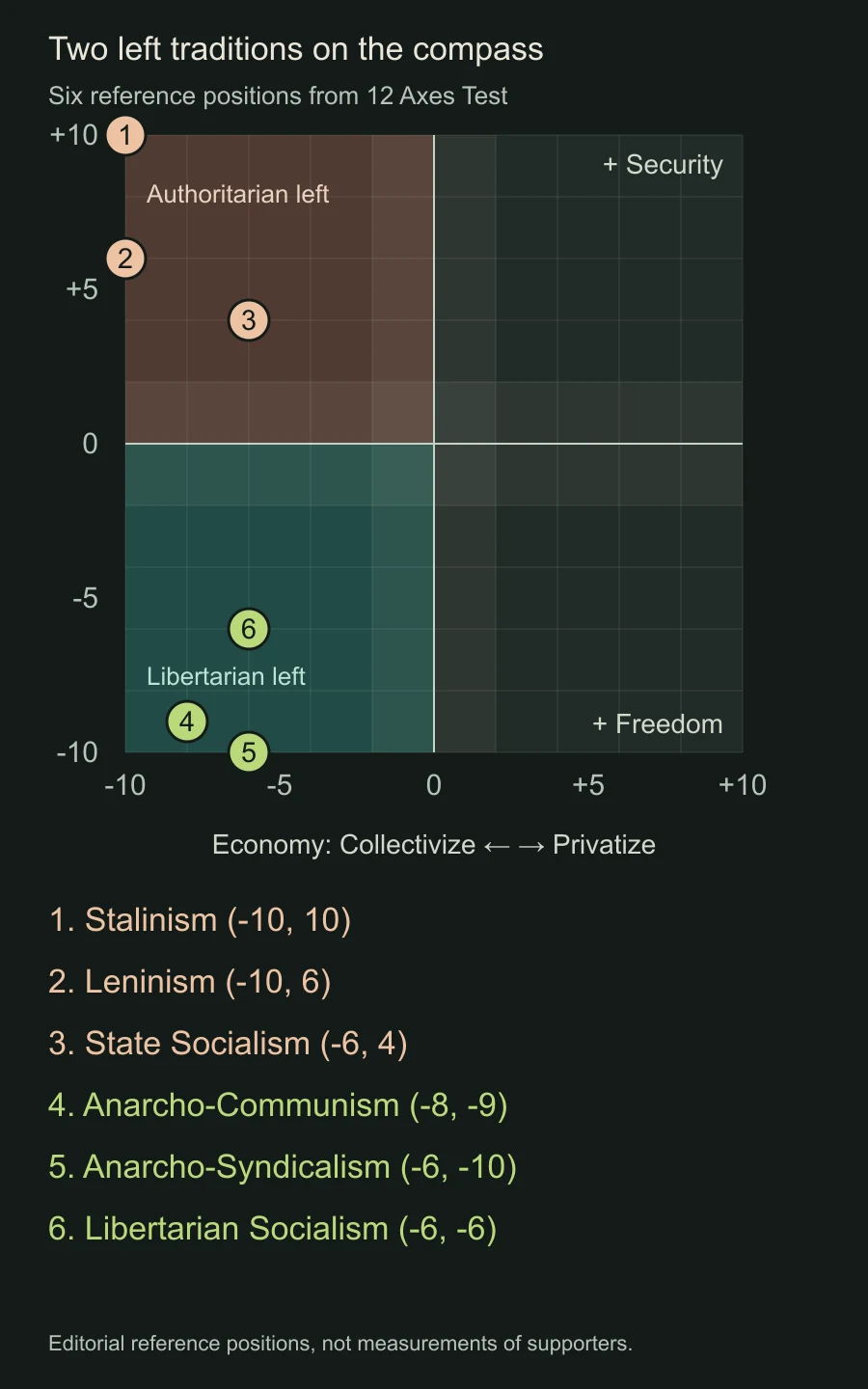
Reference positions from this site’s ideology data, with the same coordinates described above. These editorial positions summarize a model; they are not measurements of every supporter.
How the 12 Axes test measures it
The compass is built from two of the twelve axes. Economy runs from Collectivize to Privatize and decides left or right; Power runs from Security to Freedom and decides authoritarian or libertarian. A score between 40 and 60 counts as balanced, so you can also land on a centre line rather than in a corner.
The other ten axes separate people inside the same quadrant. Two libertarian leftists can disagree sharply on culture, borders or religion, and two authoritarian leftists can disagree on foreign intervention. The twelve axes page explains each one, and how to read your results shows what the percentages mean.
Common misconceptions
- "Libertarian left just means liberal." Liberals usually keep markets and private property; the libertarian left wants to replace them with common ownership.
- "Every communist is authoritarian." Anarcho-communists are among the most anti-state people on the chart.
- "The libertarian left has never existed in practice." It has existed in regions rather than states: the Free Territory in Ukraine (1918–1921), Catalonia and Aragon during the Spanish Civil War, and the Zapatista communities of Chiapas since 1994. None lasted as a nation-state, which is itself part of the argument between the two camps.
Which side are you on?
Ask yourself three questions. Would you give full control of the economy to a government run by people who share your goals? Is a free press worth keeping if it helps your opponents? Should a workplace answer to a ministry or to its own workers? If you lean toward the state, you are probably closer to the authoritarian left; if you lean toward assemblies and councils, you are probably closer to the libertarian left.
The most reliable way to settle authoritarian left vs libertarian left for yourself is to measure it. Take the 12 Axes test: 60 statements, about nine minutes, and your result shows your exact point on the compass alongside the closest ideologies, countries and figures.