
Authoritarian left vs authoritarian right separates two questions that a single political line can hide: how economic resources should be owned and how political authority should be constrained. In this comparison, both positions permit concentrated power, but their economic commitments differ. Neither the size of a government nor the presence of private businesses answers both questions at once.
Use “left” and “right” here in an economic sense, with attention to productive property. Cultural beliefs and political alliances require additional information. This guide compares institutions and the site's editorial profiles, rather than labeling contemporary countries, parties or living people. Its practical aim is to help you read a proposal without confusing state direction with a particular ownership system.
Authoritarian left vs authoritarian right
A two-axis model places economic organization on one dimension and political power on another. Moving across the upper part of that model changes the economic answer without necessarily changing the authority answer. That is the comparison's main value: it leaves room for disagreement about property among positions that share a willingness to concentrate power.
The labels remain broad. They do not tell you who runs every enterprise, what every law permits or which institution reviews an official's decision. A useful comparison first identifies the relevant economic commitment and then asks how decisions can be challenged. If an explanation supplies only a name, it has not yet described the institution.
Do not treat the chart as a claim that two traditions are interchangeable. An equal value on one axis leaves other values, arguments and arrangements open. Likewise, a different economic position does not establish that every political institution differs. The model helps separate questions; the answer to one question should not silently become an answer to all the others.
Political accountability
OpenStax's introduction to political regimes describes authoritarian arrangements with power not effectively checked through popular electoral approval. The institutional question is who can hold rulers accountable, rather than whether an official describes a policy as public-spirited or economically efficient.
For a concrete reading exercise, identify the decision maker, the scope of the decision and the available challenge. Can people criticize a policy without losing their ability to participate? Can an independent body review a decision? Can those governed replace the people exercising authority through meaningful competition? A proposal needs more than an assurance that its leaders will act well.
The distinction matters in authoritarian left vs authoritarian right because a public objective does not establish a public constraint. A decision may be justified in the language of equality, security or national development. You still need to inspect who has final authority and what prevents that authority from overriding an effective challenge.
This is an analytical checklist, not a rating of any real government. Evidence about actual institutions would need to be gathered independently. A phrase in a speech, a government program's title or a profile's name cannot substitute for that evidence. Keep statements about intentions separate from statements about the procedures people can actually use.
Ownership and direction
The Stanford Encyclopedia of Philosophy's discussion of socialism distinguishes social control of production from state power alone. Its distinction is useful here: expanding an official's ability to direct economic activity does not automatically establish collective or democratic control over productive resources.
Think of ownership as a set of questions about rights, rather than a single name on a building. Who can sell the assets? Who receives the remaining income after costs? Who chooses investment? Who bears losses? These answers can differ from the answer to who issues permits or sets operating restrictions.
A private enterprise might need an official's permission to operate. The permission gives the authority leverage, but it does not by itself transfer the enterprise's assets or residual income to society. Conversely, public ownership does not by itself explain whether workers or citizens can effectively control managers. Both cases need a description of decision rights.
To compare economic positions, list the specific rights that change. A rule altering the owner is different from a rule limiting an owner's actions. Either may matter substantially, but they should not be described as the same institutional change. “The state is involved” is the beginning of an inquiry, not its conclusion.
A warehouse example
Imagine two fictional warehouse arrangements. In arrangement A, productive assets are held in common through a public body. In arrangement B, several firms keep title to their warehouses and receive the remaining business income. Assume the same central authority can approve access to the storage district in both arrangements, with the same restrictions on challenging its decisions.
This thought experiment holds one authority rule constant while changing economic rights. It does not represent a real port, a full economy or a policy recommendation. It simply shows why knowing who controls the gate does not establish who owns the buildings behind it. The cover's keys and blank records illustrate that distinction rather than document a real institution.
Now ask about the people using the warehouses. What rights do workers have over management? How are storage services allocated? What happens when a manager makes a mistake? Those questions remain unanswered by the ownership description. A complete proposal would need to supply the procedures instead of relying on the reader to imagine favorable ones.
Change the experiment again: allow an independent appeal against the access decision while leaving ownership unchanged. You have altered political accountability without necessarily altering the economic title. The exercise does not predict outcomes, but it identifies exactly which claim has changed and which claims still require support.
Three editorial profiles
The ideology catalog makes the distinction visible through a specific set of model values. These are editorial estimates, not measurements, supporter percentages or universal definitions. The columns show the share assigned to the named first pole of each axis.
| Site profile | Economy: Collectivize share | Power: Security share |
|---|---|---|
| Leninism | 100 | 80 |
| State Capitalism | 30 | 80 |
| Authoritarian Capitalism | 20 | 90 |
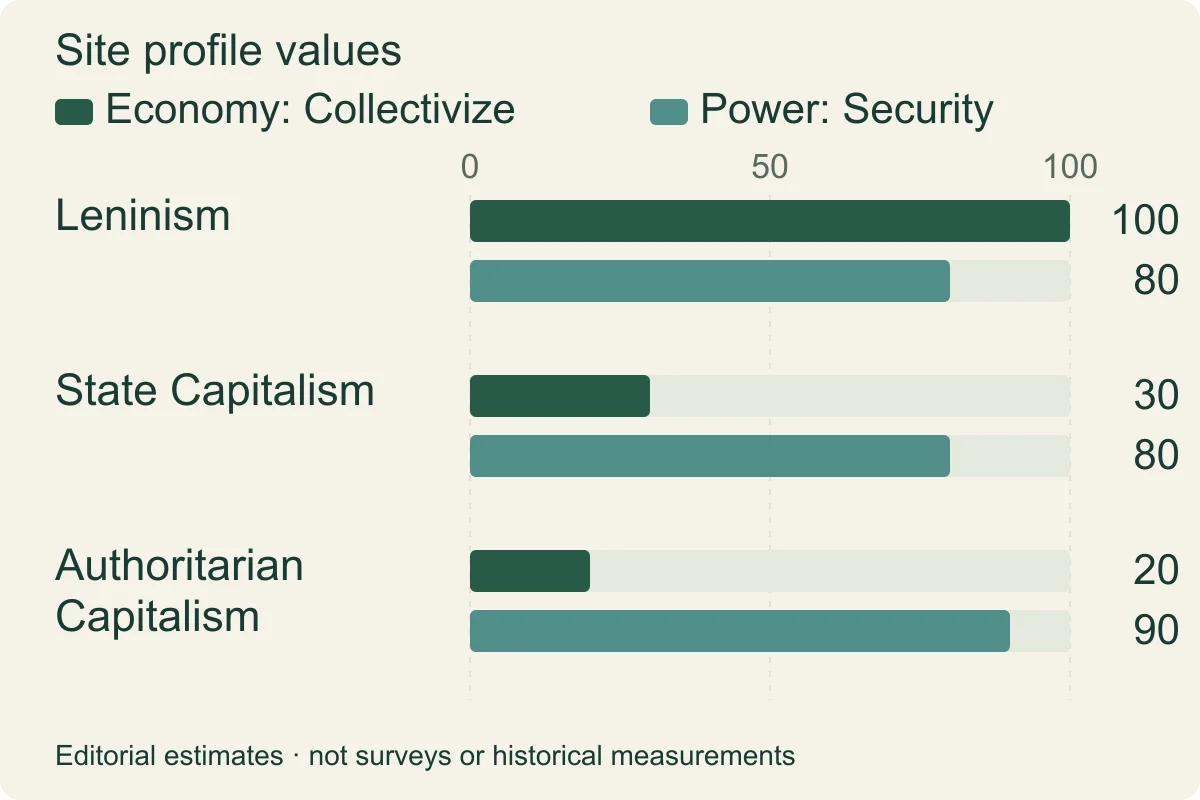
Chart generated directly from the site's profile data. It visualizes editorial estimates on a 0–100 scale, not surveys or historical measurements. Longer bars indicate a larger first-pole share within this model, not better performance or a larger population.
The first two profiles share a Power value of 80 and differ on Economy. This is a concrete illustration of separate dimensions, not evidence that their institutions, histories or supporters are identical. The third profile has its own combination. None of these entries is a measurement of the authoritarian left or right as a whole.
The State Capitalism entry also illustrates why a name containing “state” does not settle the economic axis. The catalog describes the state owning or directing major firms that operate for profit. Read that as the site's selected profile, with explicit limits; do not convert the entry into a universal definition of every use of the term.
A comparison worksheet
For an authoritarian left vs authoritarian right comparison, make two columns before assigning a label. In the economic column, record asset ownership, management rights, investment and residual income. In the political column, record who can issue binding decisions, how dissent is protected and what effective review or replacement is available.
Write “unspecified” when a proposal gives no answer. This is more informative than completing every blank from its slogan. If ownership is shared but accountability is unknown, keep both observations. If ownership is private but political challenge is restricted, record that combination rather than assuming the first fact cancels the second.
The twelve axes offer more detail than a two-dimensional picture, while the political compass supplies a compact overview. Neither replaces an explanation of the institutions you are comparing. Use the smaller model to organize questions, then return to the concrete rights and procedures behind each answer.
Use authoritarian left vs authoritarian right as a distinction between dimensions, not a shortcut for judging real people. The 12 Axes test can help you compare economic preferences with your views about power and personal freedom. Its result is a starting point for reflection, and the reasons for your answers matter alongside the nearest profile.